

What is Imbolc, and who is Brigid?

The long, cold, and dark month of January ends today. Tomorrow, the first day of February, marks the stirrings of the Gaelic celebration of Imbolc; the festival of returning light, and the celebration of one of our favourite Goddesses…
While ‘true’ Spring days still feel a little way off for us here in Scotland, there are glimmers everywhere, many of which have sprung up in the last couple of days as if to welcome in Imbolc. The first snowdrops are breaking up the brown carpet of winter leaves with their bright white heads, the sun’s beams are spilling over the horizon a little earlier each morning, and the witch hazels' fiery flowers are awakening the countryside with their spiced scent.
The festival of Imbolc is generally celebrated on 1st February, while others celebrate between 3rd and 6th February where the true astronomical ‘midpoint’ between the Winter and Spring Solstices lie. Imbolc derives its name from the Old Irish i mbolg which translates as ‘in the belly’ and oimelc meaning ewes milk ; it falls in the very first days of February where pregnant or lambing sheep would begin to produce milk, and the white snowdrops would begin to push through the frozen earth. Spring is very much ‘in the belly’ here at present; it’s gestating, in waiting, and will be with us very soon.
In Scotland, particularly along the beaches that surround us here at Barocco, swooping clouds of oystercatchers arrive; wintering groups join together with local colonies to begin the breeding season, sometimes in awe-inspiring numbers. They often do this with remarkable ceremony and punctuality - as is nature’s fascinating way - on February 1st. In Gaelic, oystercatchers are called Gille Brighde; Brigid’s Servants. They signal the arrival of the Goddess or Saint Brigid (or Bride/Brighid/Brigdhe) who is also celebrated on February 1st, St Brigid’s Day; a day often intertwined with Imbolc within Pagan and indigenous Celtic cultures. The legend goes that the goddess Brigid was being pursued by dishonourable men, and found herself on a wild, open, rocky beach with nowhere to hide. Oystercatchers, seeing her distress and knowing her divine soul, flew to her; each one with a strand of green seaweed in its beak. One by one, the oystercatchers laid the seaweed upon her, covering her until all that could be seen was what looked like a seaweed-covered rock. The men, perplexed and infuriated by her apparent disappearance, abandoned their hunt. Now, we greet the arrival of Brigid’s Servants as a welcome sign that Imbolc is here; Brigid has arrived, with her comes Spring.

Brigid has been worshipped as both a Saint and a Goddess by both Christian and Pagan Celtic people for well over two thousand years - something that makes her truly special, because the two religions did not and do not often share the same sentiments.
She is the triple goddess of fire - the fire of poetic inspiration, the fire of health and fertility, and the fire of metalworking and crafts. How stunning is the flame-haired Namielle, embodying Brigid in our Vagabond skirt and choli combo?
In her water form, Brigid is celebrated as the goddess of healing, with many springs and wells dedicated to her across Celtic lands. She is the goddess of midwifery, weaving, brewing, blacksmithing, guardian of children and livestock, and many more forms of alchemy, transformation, purification, protection and renewal.
Brigid is depicted as a flame-haired woman, and is associated with three key colours; the first of which is white. White depicts milk, as in oimelc; nourishment, fertility and birth, new cycles and lives beginning. It is traditional to leave milk out overnight on Imbolc as an offering to Brigid, or to pour it onto the ground to bless the earth and welcome in new growth. Some also like to bathe in water with some milk added, or to drink warmed spiced milk. Many people like to light a white candle with three wicks, symbolising the three fires that Brigid brings.

This stunning shot featuring our bridal wear Evangeline gown and Tempest skirt was taken by the talented @lady_sabath_photography of the very beautiful Brigid-esque @mela_nch0lia_cosplay.
With three candles symbolising the three fires, white ribbons symbolising the Brat Bhríde, and the pristine snows that have blanketed much of the country as winter savours its last few months before giving way to Spring’s bounty, it's the perfect shot to capture Brigid's pure energy.
We are besotted with this image! But what is the Brat Bhríde, I hear you ask?
It's one of the most famous and most regularly observed traditions of Imbolc, where a piece of cloth or ribbon is left outside on January 31st to be blessed by the Goddess or Saint and soaked in the morning dew, bestowing protective powers upon the cloth. This powerful ritual connects both the Christian and Pagan worlds in honouring and asking for protection from Brigid. The cloth is then brought inside before sunrise on Imbolc and used for ailments, childbirth, and in animal care, or placed on an altar within the home. It’s one of those simple rituals that anyone can do - a ribbon, a scrap of cloth, a garment of clothing; anything can be hung outside overnight, then brought inside upon waking in the morning. Whether you believe in blessings from goddesses or not, sometimes carrying out such a ritual brings its own kind of comfort, and a welcome moment to pause in the morning air and connect with the ‘older ways’; with a time when life wasn’t so frantic.
Brigid is, by all accounts and across all the cultures, religions, groups and people who celebrate her, the ultimate woman; strong, intelligent, skilled in all the practical skills necessary for supporting a thriving community, brave, creative, a protector and healer, and the source of creative fire for poets and storytellers.
Needless to say, she is beloved, across the ages, across religious divides, across borders and, dare we say, through the veil; and, on the eve of Imbolc, we are feeling her creative fire within us here at Barocco.
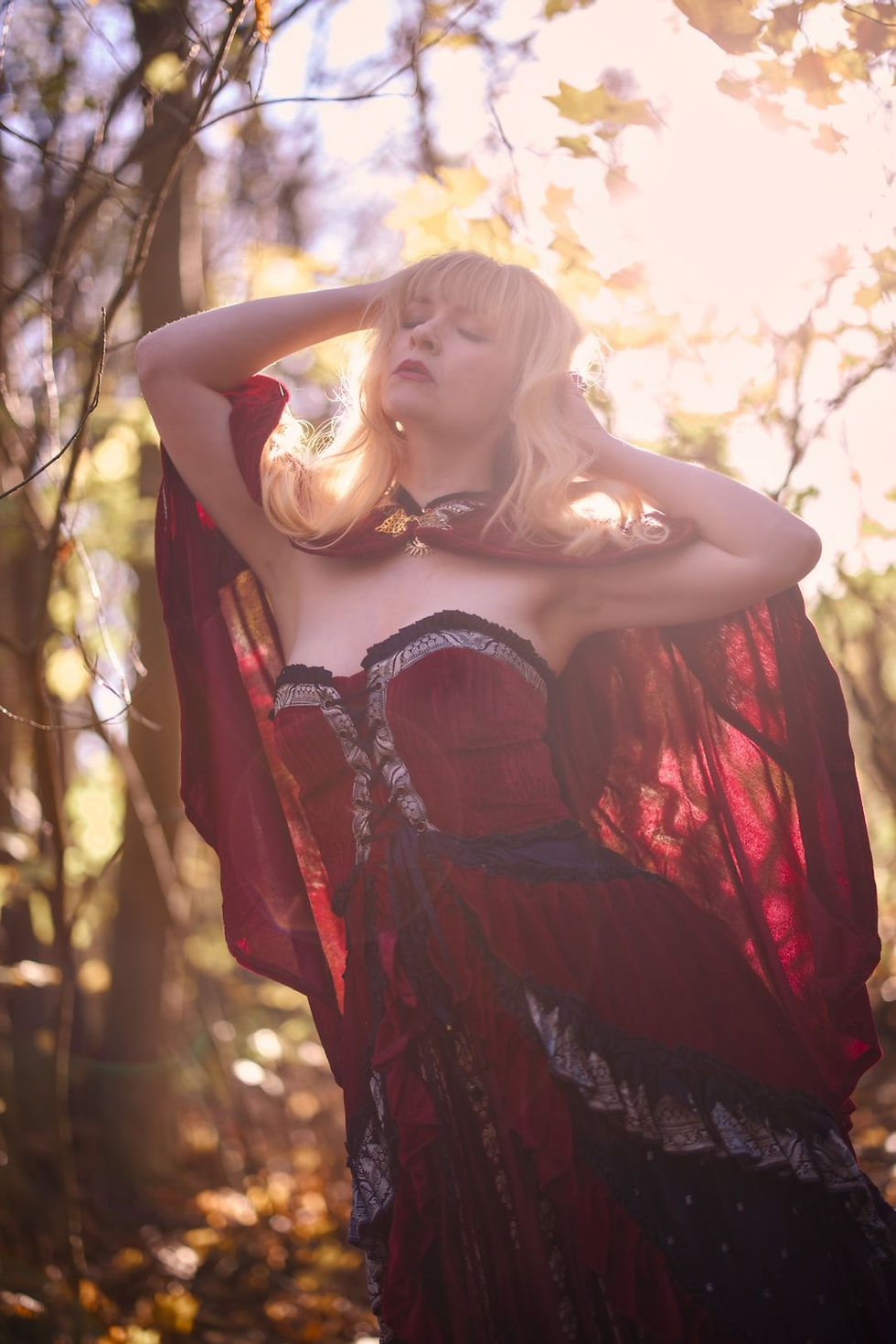
Another colour heavily associated with Brigid is green, symbolising new growth, and the natural world coming back to life as Spring begins to warm our land. She is often depicted as wearing a green mantle or cloak; it may interest you to know that we have some beautiful, goddess-worthy green cloaks joining our collection soon... but in the meantime, allow yourself a moment to take in the beautiful Namielle, captured by the wonderful @lorethesiren, wearing our iconic Vagabond skirt.

Will you be celebrating Imbolc, or Brigid, tomorrow? Remember, every ritual, celebration or tradition is totally unique and meaningful to the person carrying it out.
Maybe it’s enjoying some warm milk before bed, making a Brigid’s Cross (here are some handy instructions that we love from Five in the Nest!) leaving out a Brat Bhríde or simply lighting a candle and taking a moment to reflect on new beginnings and the coming of Spring; you can make Imbolc your own, and celebrate your inner Brigid in whatever way feels right to you.


Comments